
Usually, we spend our April holidays in Italy visiting Johnny’s family and doing a bit of sightseeing. We also go to Italy in August for about ten days every year, but those trips are purely beach holidays—it’s simply too hot for sightseeing in August. This year, however, Italy had very strict Covid restrictions in place in April, and it was not even possible to travel from one region to another. We needed an alternative destination.
Southern Spain had been on our minds for a while, and this seemed like the perfect opportunity. We really needed a break from France and all the restrictions. Spain also had rules, of course, but at least it was still possible to eat in restaurants and take evening walks.
I booked us Ryanair tickets to Malaga from Marseille. This was our only option, as there were no direct flights from Nice at that time. Complicating matters, the French government had changed the school holiday dates at the last minute, moving them two weeks earlier. The kids had to continue Zoom lessons while traveling, though they only missed two days of in-person school. Despite the added planning, we didn’t want to cancel—we were far too excited for this trip.
On April 26th, we drove to Marseille (just under two hours from home) and decided to spend the night there before our flight. We stayed at the Holiday Inn Express Marseille, a short walk from the city center. The hotel was mostly empty due to the ongoing restrictions. Breakfast was served via pre-prepared trays, which we had to order in advance using breakfast cards. Restaurants were still closed in France, and a 7 pm curfew meant we had dinner via Uber in our hotel room. Despite all the limitations, the staff were incredibly friendly, and the hotel felt welcoming—it didn’t even feel like France in the midst of restrictions!
Ryanair turned out to be perfectly fine for this short hop. The seats were a bit narrow, as expected, but for a two-hour flight it wasn’t a problem at all. We kept our masks on during the flight, as required, and the kids handled it well, feeling excited for the start of our trip to Southern Spain.
Upon arrival in Malaga, we had to show the QR code from the Spain Travel Health website. We had completed the forms and uploaded our PCR test results a day in advance, and the codes arrived quickly via email.Without this code it not possible to enter Spain.
We had reserved a rental car in Malaga airport with Wiber car rental. Wiber doesn’t have a desk in the airport, but their shuttle service was efficient, and we soon picked up a Ford Focus estate with full insurance, perfect for our week-long road trip. Their service is very good and prices reasonable (178 euros per week with full insurance for a Ford Focus estate), I would definitely use them again.
With the car loaded, we set off towards Seville, our first destination. The drive took about two and a half hours along smooth highways, giving us time to admire the Andalusian landscape—olive groves, rolling plains, and small whitewashed villages scattered along the hillsides. Even under Covid restrictions, it felt so good to finally be on the road again, breathing in the warm spring air and feeling the excitement of our first trip during the last six months.
We had not travelled for a while and wanted to treat ourselves a bit, so we had chosen to stay at Barcelo Sevilla Renacimento hotel. It is a nice five-star hotel just a bit outside the center of Seville and we had booked two rooms there. We were really happy with the choice of the hotel - the rooms were spacious with comfy beds, the breakfast was great with lots of choice (also vegan) and it had a half indoor/half outdoor pool where we could relax after a day of sightseeing.
Double room in Barcelo Sevilla

Hotel pool

Seville is the capital and largest city of Andalusia, with the a population of about 1.5 million, making it the fourth-largest city in Spain. Seville is approximately 2,200 years old. The passage of the various
civilizations instrumental in its growth has left the city with a
distinct personality, and a large and well-preserved historical centre. As we arrived at Seville late afternoon, we only went for a short walk in the evening, the rest of the time we just relaxed in the hotel. We also had dinner in the hotel restaurant and found the quality of food really good.
The next morning we were ready to discover this wonderful city and at first we headed to Plaza de Espana - the main square, and Parque de María Luisa just next to it. Plaza de Espana is relatively recent - it was built in 1928 for the Ibero-American Exposition of 1929. It was one of the most beautiful city squares that I have seen - maybe it was for the lack of tourists (as it can be seen on the photos, there was hardly anyone around), but we were all amazed by its beauty.


Adjaent to the Plaza de Espagna is Maria Luiza Park, the principal green area of Seville. The park is in 'Moorish paradisical style' with lots of of tiled fountains, pavilions, walls, ponds and benches. There are lush plantings of palms, orange trees, Mediterranean pines, and stylized flower beds with bowers hidden by vines. It is definitely worth a visit and a stroll around.


Seville is a wonderfully walkable city, where narrow streets wind past buildings from different eras, each turn revealing another layer of history. From there, we made our way to the Royal Alcázar Palace, just a short stroll from the Plaza de España. The Alcázar of Seville is one of the city’s most iconic landmarks—and not just for Seville, but for Spain and the Mediterranean world as a whole. What makes it truly special is the way Islamic, Mudéjar, Gothic, Renaissance, and Baroque styles come together in a single, harmonious complex. Its designation as a UNESCO World Heritage Site in 1987 recognizes this rare coexistence of cultures and civilizations, blended into a beautifully balanced whole (source: alcazarsevilla.org).
During our visit, entry was carefully managed to preserve the palace experience. Tickets had to be purchased online in advance for a specific time slot, a system designed to control the number of visitors inside. While it required a bit of planning, it made exploring the Alcázar feel calmer and more immersive—well worth the extra effort.


Just opposite the entrance to the Alcázar stands another of Seville’s most iconic landmarks: the Cathedral and La Giralda. The Giralda is a tower of unparalleled scale for its time, dating back to between the 12th and 16th centuries. For many years, it was the tallest building in the world, reaching 101 meters when including the Giraldillo—the elegant weathervane that crowns the tower and has become one of the city’s enduring symbols. La Giralda is a perfect example of Seville’s layered history, a harmonious blend of architectural styles and civilizations. Originally built as a minaret, it later became a bell tower, embodying the city’s cultural evolution (source: visitsevilla.es).


By the end of the day, after hours of sightseeing, we were more than ready to slow down and indulge in one of Seville’s greatest pleasures: tapas. We chose a cozy restaurant in the pedestrian area and enjoyed a generous spread of different dishes, each one as delicious as the last. The biggest surprise came with the bill—just 39 euros for a satisfying and memorable meal.

With a bit of energy still left, we took one final stroll through Seville’s narrow streets before calling it a night and heading back to our hotel.


The next morning, we set out to explore one of our favorite things when traveling: local markets. We especially love food markets that double as casual dining spots, where you can sample regional specialties right at the counter. According to Google, Seville’s most popular market is Mercado de Triana, so we decided to see it for ourselves. The market had everything we look for—a traditional food market selling local goods, alongside lively stalls serving ready-to-eat dishes. Although we’d already enjoyed a hearty hotel breakfast and weren’t hungry, the aromas and displays were undeniably tempting.

It was time to pack our suitcases once again and set off toward the coast. For the next five nights, we had booked an Airbnb apartment in Puerto Banús, near Marbella. Rather than taking the fastest route, we opted for a more scenic drive, planning a stop in Cádiz along the way.
Cádiz is one of the oldest continuously inhabited cities in Western Europe, with archaeological remains dating back to the 8th century BC. Founded by the Phoenicians, the city sits on a narrow peninsula along Spain’s Atlantic coast, meaning it is almost entirely surrounded by the sea. It’s an ideal setting for a leisurely seafood tapas lunch, with the ocean never far from view. The beaches around Cádiz are long and sandy and have been voted among the best city beaches in Europe by Lonely Planet.


The apartment turned out to be a perfect choice. Spacious and modern, the three-bedroom space was tastefully decorated and opened onto a huge terrace. To top it off, our host, Pepi, had thoughtfully welcomed us with a bowl of fresh fruit in the kitchen and a fully stocked fridge—juices, soft drinks, beer, and even wine. It was a warm, generous welcome and a wonderful place to settle into the rhythm of the coast.


We had an early start the next morning, setting off for Granada to visit the famous Alhambra palace complex. Located inland at the foot of the Sierra Nevada mountains, Granada is about a two-hour drive from Puerto Banús. Sitting at an elevation of roughly 730 meters, the city is noticeably cooler than the coast. Even though we had thoughtfully packed sweaters, the air still felt surprisingly chilly.
We had purchased our Alhambra tickets online in advance, as visitor numbers were limited due to COVID restrictions and tickets were not available for purchase on site. When booking, we were able to choose a specific time slot for visiting the Nasrid Palaces—an important detail, as entry is only allowed at the exact time stated on your ticket.
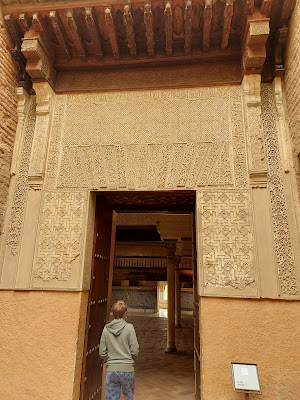


Granada itself is a charming town, and after our visit to the Alhambra we planned to enjoy a leisurely meal and then spend some time wandering through the streets. As it turned out, the day had other ideas. We did manage to enjoy a delicious lunch in the city center, but while we were eating, the rain began to pour. When it became clear that it wasn’t going to let up anytime soon, we reluctantly changed plans and headed back to the coast.
After several days of long drives, we decided the next day would be a slower one. We set our sights on nearby Marbella, planning a relaxed outing that included lunch at a seaside restaurant and afternoon drinks with friends who live in the area. One of the highlights of the day was the seaside promenade connecting Puerto Banús and Marbella. Stretching for about seven kilometers one way, it’s perfect for a scenic coastal walk—though we only covered part of it before turning back, content to enjoy the views at an unhurried pace.


The next morning, we found ourselves back in the car once again, this time heading toward Gibraltar. It felt slightly surreal to be visiting a small slice of Britain—just 6.8 square kilometers in size—on the edge of the Mediterranean. The drive from Puerto Banús took a little over an hour, and just before the border we found large parking areas on the Spanish side, where we left the car and continued on foot.
Crossing into Gibraltar involved two passport checks—one to exit Spain and another to enter Gibraltar—after which we were free to explore. It was only about a ten-minute walk from the border to the old town, and almost instantly it felt like we had stepped into the UK (weather aside, of course). It was a Sunday, and restaurants were advertising traditional Sunday roasts, carveries, and fish and chips. British shops lined the streets, all signage was in English, and the sound of English voices filled the air.
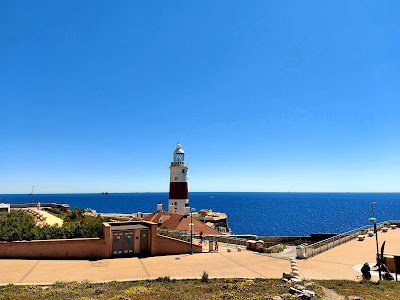
We initially planned to take a bus up the Rock of Gibraltar to visit the caves and see the famous monkeys. However, after chatting with some locals at the bus stop, we learned that the caves and parts of the Nature Reserve were closed due to COVID restrictions. Instead, we opted for a different bus that took us to Europa Point, the southernmost tip of Gibraltar. Standing there, at the very edge of the European continent, we could clearly see the African coastline across the 14-kilometer-wide Strait of Gibraltar.
The Strait itself is the only natural link between the Atlantic Ocean and the Mediterranean Sea and one of the busiest waterways in the world—a fittingly dramatic backdrop to end our visit.




Our last day in Spain was spent exactly the way we like to end a trip: sharing a wonderful lunch at the home of Estonian friends who live in the area. Through years of traveling, we’ve made friends in many different countries, but this one is especially meaningful—I grew up with him. There’s something comforting about seeing a familiar face in a faraway place, and even after years without meeting, the conversation flows effortlessly, as if no time has passed at all.
Practical matters also had to be taken care of before heading home. We needed PCR tests in order to enter France, and this turned out to be one of the more expensive parts of traveling in Spain. In France, COVID tests—including those needed for travel—were covered by Social Security, and for those without coverage, PCR tests cost around 45 euros. In Spain, however, testing had clearly become big business, with prices ranging from 120 to 180 euros. We had our tests done at Clínica Boris in Marbella for 130 euros per person, a significant addition to the travel budget—especially when traveling as a family.
Our flight from Málaga back to Marseille was quick and straightforward, and by the time we returned, France had also begun to ease some of the restrictions that had been in place since late October 2020. Even so, the trip had already felt like a small luxury. Being able to enjoy simple pleasures—dining in a restaurant, staying out after 7 p.m., or visiting a museum—made the holiday feel especially meaningful.
Andalusia is a beautiful region, rich in culture and history and blessed with lovely beaches. We left knowing there were still many places we hadn’t had time to explore, which is always the best reason to return someday.


No comments:
Post a Comment