Many destination ideas somehow just find their way to us. After watching Pékin Express on French TV in the winter of 2022 (the show is known as The Amazing Race in English), part of which was filmed in Jordan, we added the country to our travel bucket list. One day we’ll go there, we said.
Then June rolled around, and we started thinking about the October holidays—somewhere not too far away, with pleasant weather and plenty to see and do. Maybe Jordan could happen sooner than we’d expected. As I’ve already mentioned in this blog, there’s a Ryanair base just two hours from us in Marseille, offering a wide range of destinations. After a bit of creative planning, I managed to find return tickets to Amman for the four of us for just over €900 with Ryanair Family Plus, which included luggage and seat selection. The catch? A one-night stopover in Paphos, Cyprus, on the way there, and two nights in Bucharest, Romania, on the way back. Adventurous as we are, we didn’t mind these little detours at all.
Jordan may be a relatively small country, but it has an incredible amount to offer, so we planned a fairly packed itinerary for the nine days we’d be spending there. The easiest way to get around is by car, so we rented one on the day we left Amman—there was no real need for a car while staying in the city itself. We also purchased our Jordan Passes a couple of weeks before the trip. The Jordan Pass combines the visa with entry to Petra and many other sites across the country. The price depends on how many days you plan to visit Petra; we chose the one-day Petra option and paid USD 99 (70 JOD) per person. It’s excellent value, and I’d definitely recommend it, as the visa alone costs 40 JOD and a one-day ticket to Petra is 50 JOD. With all the planning done, we were officially counting down the days to our next adventure.
The flight from Marseille to Paphos took about three and a half hours. We arrived quite late in the evening, around 8 p.m., and since our flight to Amman was scheduled for early the next morning, I’d booked a simple apartment close to the city centre. The evening weather was still warm and pleasant, so we went out for a short walk and dinner. We found a small, family-run local restaurant—well rated on Google—and enjoyed a delicious meal of local specialities on the outdoor terrace. Paphos had a relaxed holiday vibe, and I hope we’ll have the chance to explore Cyprus more thoroughly one day. With a taxi picking us up at 4:30 a.m. for our 6:30 flight, though, it was clear the night was going to be a short one.
We were up early the next morning, and the one-hour flight from Paphos to Amman went smoothly. Getting out of the airport took a bit longer than expected: first a queue to have our Jordan Passes checked (and for those without one, to buy a visa), followed by another queue for passport control and stamping. Since we’d arrived early and knew our hotel room probably wouldn’t be ready yet, we decided to take the airport bus into the city centre. It’s the cheapest option at 2.5 JOD per person, but also the slowest, taking about an hour and a half. While we were on the bus, it even started to rain—quite a rare sight for a desert country. Before boarding, we’d exchanged some local currency; the Jordanian dinar (JOD) is stronger than the euro, with €100 converting to around 70 JOD.
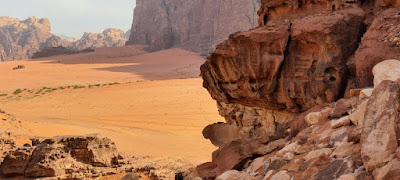
Sunrise over the desert landscape of Jordan
We chose to stay at a hotel close to the city centre and Rainbow Street: The House Boutique Suites. From the bus station, we took a taxi to the hotel, and even though we arrived early, our room was ready after just about 15 minutes— while we enjoyed a refreshing juice on the comfortable sofas in the reception area.
We were immediately delighted with our two-bedroom, two-bathroom suite. The moment we stepped inside, we all unanimously decided to head straight to bed to make up for the previous short night. The hotel was exceptional, with excellent service, a spacious and comfortable room, and a very good breakfast offering both local and international options. I also really appreciated the laundry room, where washing machines and dryers were available for guests to use free of charge, while the kids enjoyed the gym.
Our beautiful suite in the House Boutique Suites
View of the city from living room window
We woke up from our nap around noon, feeling rested and ready to explore the city. Rainbow Street was just about a block away from our hotel, so that’s where we headed first. We stopped at a small café for a light bite before continuing on.
A quick bite before heading to town
Amman is a fascinating city. Built on a series of hills, you’re almost always walking either uphill or downhill. In steeper areas, stairs help make the climb a little easier, but distances still tend to take longer to cover than they appear on the map. With a population of just over four million, Amman is the largest city in Jordan and the fifth largest in the Arab world. Remarkably, the earliest evidence of settlement here dates back to the 8th millennium BC, and the city has been continuously inhabited ever since—making it one of the oldest cities in the world.
From Rainbow Street, we followed a maze of staircases down into the heart of the street markets, the souks. The area was lively and pleasantly chaotic, filled with the sounds, smells, and energy of a true Middle Eastern market. We stopped for freshly squeezed pomegranate juice from one of the many vendors and simply soaked up the atmosphere. Our particular favourite was the fruit and vegetable souk, bursting with colour and life.
With well over 15,000 steps behind us, we decided it was time to head back to the comfort of our hotel. Before returning, we stopped on Rainbow Street to pick up a large takeaway shawarma plate from “The World’s Best Shawarma”—and those in our group who tried it can confidently say it lived up to its name.
The kids decided to call it a day after a quick gym session back at the hotel, but Johnny and I still had some energy left. We headed back out for another stroll along Rainbow Street, this time to experience it by night, when the area takes on a whole new atmosphere.
Breakfast at the hotel offered a mix of local specialties alongside the usual international choices. For plant-based eaters, there was always hummus, mutabal, falafel with fresh vegetables, and local flatbread. I was initially excited by the variety, but it did start to feel a bit repetitive as the trip went on. Plant-based milk cappuccinos were only available in the larger hotels. Otherwise, there was plenty of local cheese—different types of feta and halloumi-style cheeses seemed to be a staple at every breakfast. Jordanians clearly have a sweet tooth; halwa and pastries were usually extremely sweet.
Our plan for the day was to visit Amman’s most important landmarks: the Citadel and the Roman Amphitheatre. The Citadel sits atop the highest hill in Amman, 850 meters above sea level, so we opted to take a taxi up and walk back down. Occupied since the Bronze Age, the Citadel is surrounded by a 1,700-meter-long wall that has been rebuilt many times over the centuries, from the Bronze and Iron Ages to the Roman, Byzantine, and Umayyad periods. Entry to the Citadel is included in the Jordan Pass. There’s also a small history museum on site, which is definitely worth a visit to gain more context about the area’s long and fascinating history.
View of the city from the Citadel
Walking from the Citadel to the Roman Amphitheatre was easy—the street gently sloped downhill, with the final stretch consisting of a few staircases. The 2nd-century amphitheatre dates back to the Roman period, when the city was known as Philadelphia. Today, it is still used for cultural events and musical performances. Entry is included with the Jordan Pass, making it a hassle-free visit.
The stairs on the way from Citadel to Amphitheatre
After exploring the amphitheatre, we wandered back through the labyrinth of souks and climbed the stairs up to Rainbow Street before returning to the hotel. Along the way, I noticed that one of the leather straps on my rucksack had broken. We also spotted an alley lined with tailors in the souks, so Johnny and I went back to see if we could get it repaired. We found a friendly tailor who fixed it for just 2 JOD. It was interesting to note that all the tailors in the souk were men, as were most of the hotel staff, including housekeepers. The only female staff we encountered at the hotel were two breakfast waitresses, both from the Philippines rather than locals.
Tailor fixing the bag
Since we would be leaving Amman the next morning, and international cuisine might be harder to find outside the capital, we decided to enjoy an Italian dinner that evening. A restaurant called Totti’s, not far from the hotel, caught our eye. The food was excellent, and we were delighted to learn that the chef was a local woman who had studied Italian cooking in Switzerland. She was thrilled to meet someone Italian in her restaurant and treated us to her delicious homemade tiramisu—a sweet ending to our time in Amman.
Totti's Italian in Amman
We were a little apprehensive about driving in Amman that morning, given the chaotic and busy traffic we had experienced in the city so far. Fortunately, it was Friday morning—the equivalent of Sunday morning in Europe—and by 9 a.m., the streets were practically empty. I had reserved a Nissan Sentra at Dollar Car Rental to start our drive to Wadi Rum, but (un)fortunately, no medium-sized cars were available, and we ended up with a large Chevrolet instead. The roads were still quiet, and it was a breeze driving out of Amman to begin the four-hour journey along the Desert Highway to Wadi Rum. We rely on downloaded offline Google Maps as a GPS during our travels, and so far, it has worked flawlessly everywhere.
We had arranged to meet Mhareb, the owner of Wadi Rum Desert Adventures, at Wadi Rum village at 2:30 p.m. Once there, we left our rental car in the village parking lot to start our desert tour by jeep, aiming to reach the camp in time for sunset. Mhareb introduced us to our guide, Ali, and we were ready to begin our adventure in one of the most unique landscapes on the planet.
Wadi Rum, a protected area and UNESCO World Heritage site, has served as the backdrop for several films, with Star Wars probably the most famous. There is an entrance fee to the Wadi Rum Protected Area, but it’s included with the Jordan Pass. The desert’s landscape is incredibly varied, featuring narrow gorges, natural arches, towering cliffs, ramps, massive landslides, and caverns. Adding to its allure, the area also contains around 25,000 rock carvings and 20,000 inscriptions that trace the evolution of human thought and the early development of the alphabet.
During our jeep tour, we visited the spring associated with Lawrence of Arabia, explored a canyon adorned with rock carvings, climbed a huge sand dune, and admired a natural arch, before finally arriving at our camp. Mhareb’s camp is one of the more remote options, offering a sense of privacy and spectacular views, situated next to a beautiful sand dune. The camp featured a large main tent for meals, a toilet and shower block shared by all guests, and several tents of varying sizes. We stayed in a family tent that contained six single beds—a cozy and comfortable base for our desert adventure.
The camp and our tent
Our desert tour




In the evening, dinner was served in the main tent. The meat had been slow-cooked underground in traditional Bedouin style, accompanied by a vegetable stew, rice, flatbread, and several cold sides like hummus, mutabal, and fresh salad. After dinner, all the guests gathered around the fire pit, sipping endless amounts of very sweet sage tea. Mhareb and his team played local instruments and sang, creating an incredibly warm and lively atmosphere.
The camp had a wonderfully diverse mix of guests from around the world—American, Brazilian, Dutch, British, French—and before long, everyone was dancing together around the fire. With no Wi-Fi or even phone network coverage at the camp, we were completely cut off from the rest of the world. The night sky, unspoiled by light pollution, was simply magical.
We slept soundly in our tent, and the next morning, after watching the sun rise over the desert, we enjoyed a good breakfast in the main tent before setting off back toward Wadi Rum village.
Drinking tea before dinner
Camp atmosphere after dinner
Breakfast in the main tent
Our next destination was Aqaba, a resort town on the Red Sea. It’s popular not only with tourists but also with locals looking for a seaside weekend escape from Amman. Although Jordan has only 27 km of coastline along the Red Sea, the area offers excellent opportunities for diving and snorkeling. We had heard that the underwater world here was spectacular and were eager to see it for ourselves.
Aqaba is less than an hour’s drive from Wadi Rum, but the climate changes noticeably as you approach the sea. While Wadi Rum had felt chilly after sunset and in the mornings, Aqaba greeted us with temperatures around 30°C during the day and rarely dropping below 20°C even in the evening.
The town has a wide range of accommodations, from luxury five-star resorts to simple guesthouses, but prices can be steep. I found a small, recently opened hotel called Twins Boutique Hotel. Officially ranked as a three-star property, we found it very pleasant—clean, comfortable, with a good breakfast, and a spacious family room that suited our needs perfectly.
Family room at Twins Boutique Hotel


Aqaba has a pleasant public beach with a promenade and small cabanas for shade, but as Jordan is a Muslim country, women are required to be covered on public beaches. Tourists wanting to sunbathe or swim in a swimsuit need to head to private beaches.
For the day, we had booked full access to Berenice Beach Club, a private beach featuring swimming pools, sun loungers, changing rooms, several bars, and, of course, an amazing stretch of sand (entrance cost 10 JOD per person). We also reserved a glass-bottom boat tour that included visits to the most well-known dive sites and reefs, with an hour of snorkeling at the Japanese Garden.
The boat tour was enjoyable, but honestly, it wasn’t strictly necessary—right at Berenice Beach, the coral reef begins just about five meters from the shore. The corals were stunning, and there were plenty of colorful fish to admire. We had an incredible day swimming, snorkeling, and relaxing on the beach—and even managed to spot a poisonous scorpionfish!
Berenice Beach Club
Aqaba is a lively town, full of bars and restaurants. Despite the many options, we ended up eating both nights at the same place: Khubza & Seneya. With excellent reviews on both TripAdvisor and Google, it certainly lived up to the hype. The food was delicious, the service friendly, and the prices very reasonable.
Soon it was time to head back inland, as we were excited for our upcoming visit to Petra, one of the world’s most famous UNESCO World Heritage sites. The drive from Aqaba to Wadi Musa, the town closest to Petra, took just over two hours. I had reserved a simple hotel called Esperanza Petra, located a bit further from the town center but only a couple of hundred meters from the Petra entrance gate.
Wadi Musa is a tourist-friendly town with plenty of hotels, restaurants, and souvenir shops. Both nights, we dined locally and were very pleased with the food. The restaurants we tried, Zawaya and Al Wadi, offered vegetarian options and allowed the kids to sample the traditional Jordanian dish Mansaf—lamb marinated and cooked in yogurt. They didn’t find it particularly exciting, but it was a fun taste of the local cuisine.
Landscape around our hotel
We woke up at 5:30 a.m. on the morning of our Petra visit. The hotel began serving breakfast at 6, so we ate early and arrived at the Petra gates just after opening time, around 6:45 a.m. (the gates open at 6:30). We had our Jordan Passes scanned to receive our Petra tickets. A one-day ticket costs 50 JOD (around 70 euros), but it was conveniently included in the Jordan Pass.
Dating back to around 300 B.C., Petra was the capital of the Nabatean Kingdom. Accessed through a narrow canyon called Al Siq, the site is renowned for tombs and temples carved into pink sandstone cliffs, earning it the nickname the “Rose City.” From the entrance, there was still about half a kilometer of walking before reaching the Siq itself. The canyon stretches for 1.2 km and ends in front of the majestic Treasury, perhaps the most iconic site in Petra. We were fully prepared for a day of extensive walking.
Early morning at the Siq canyon
Camels in front of Treasury
We decided to start with the High Place of Sacrifice path. Most visitors skip this route, as it involves a long climb with many stairs, but it was stunning. The views were spectacular, and for most of the walk, it felt like we had the site almost to ourselves. Along the way, we passed lesser-known tombs and temples, adding a sense of discovery to the hike. The path eventually led to the museums, from where we began the climb to the Monastery.
The High Place of Sacrifice path
Along the way, many local Bedouin men tried to sell us donkey rides, claiming there were 1,000 steps to reach the Monastery. In reality, there were 780 steps—still quite a climb! The steps were old and sometimes uneven, but the effort was more than rewarded once we reached the Monastery. Local vendors lined the steps, selling everything from tea and pomegranate juice to souvenirs and carpets—reminders that around 30 Bedouin families still live in Petra. At the Monastery, a small coffee shop provided a perfect spot for a picnic before we made the descent along the same steps.
The Monastery and the climb down
Pomegaranate juice break with a view Although we were getting a little bit tired at this point, we did not want to call it a day yet. We still went to do the Royal Tombs path and as a last effort also a climb to see the Treasury from above.
Another break with the view on the way to see the Treasury form above
The Siq canyon felt much longer on our walk back to Petra’s main entrance. By then, we were all thoroughly exhausted—my step tracker recorded over 33,900 steps, totaling more than 22 km for the day. After a refreshing hot shower and an early dinner, we all turned in for the night. We had probably done the maximum possible in Petra in one day, only missing Little Petra. Some quick tips for a great visit: go early, wear sturdy shoes, bring plenty of water and snacks, and take breaks when needed.
The next day, we began our journey north, though we still had a couple of stops planned before leaving Jordan. Our next destination was the famous Dead Sea, the lowest point on Earth at 430 meters below sea level. From Wadi Musa, the drive took a little over three hours. The route offered a mix of rocky landscapes, scenic valleys, and, in the final stretch, a stunning drive along the Dead Sea coastline.
After researching several options online before our trip, I realized that the best way to experience the Dead Sea was to stay at one of the resorts. The natural shores are quite steep, and finding a safe and comfortable entry point on your own would have been tricky. While the resorts are on the expensive side, we felt it was worth every penny.
We stayed at the Hilton Dead Sea, a beautiful property with spacious rooms—our family had connecting double and twin rooms—lush gardens, several swimming pools, and excellent facilities for enjoying the Dead Sea itself. Once we checked in, we headed straight to the main attraction.
The resort featured a small artificial sandy beach with sun loungers, showers, and clear instructions on how to make the most of the Dead Sea experience. The water was incredibly salty—definitely avoid getting it in your eyes—but floating effortlessly was surprisingly relaxing. Afterwards, we covered ourselves in the mineral-rich mud provided in large ceramic bowls near the showers. The mud left our skin feeling soft and rejuvenated, adding a fun, almost spa-like touch to the experience.
Our final day in Jordan began with a leisurely breakfast, enjoying the stunning views of the Dead Sea. Although it was our last day, we still had a few must-see spots to tick off our list, and we planned to spend the evening in Madaba, a town famous as the “City of Mosaics” and conveniently closer to the airport than Amman.
The drive from the Dead Sea to Madaba took about an hour, passing Mount Nebo, a pilgrimage site since the 4th century. According to the Bible, Moses ascended Mount Nebo, in the land of Moab (modern-day Jordan), and from there glimpsed the Promised Land—a land he was not permitted to enter. Moses is said to have died there. A Byzantine-era Christian church now stands at the summit. The entrance fee was 3 JOD per person, one of the few sites we visited that wasn’t included in the Jordan Pass.
Mosaic floor in the diaconicon-baptistery
In Madaba, we had reserved two rooms at a small B&B called Coco Guesthouse, a recently opened property with simple rooms and very reasonable prices. The town is famous for the 6th-century Mosaic Map of Jerusalem and the Holy Land, located in the Greek Orthodox Church of St. George. From our B&B, it was a pleasant 20-minute walk to the center, which is very compact and easy to explore.
We spent the afternoon strolling through the streets, doing a bit of souvenir shopping, and visiting a couple of churches and local sites. For our final evening in Jordan, we enjoyed a relaxed dinner before turning in early, preparing for our early flight the next morning. Our flight to Bucharest departed at 9:30 a.m., and we also needed to return our rental car. After a quick breakfast at 6:45, we were on the road by 7 a.m. Madaba’s close proximity to the airport—just about 20 minutes—made the start of our journey home stress-free.
Mosaic Map of the Holy Land
Our last dinner in Jordan
We left Jordan feeling truly happy to have discovered this remarkable country. It’s a wonderfully varied Middle Eastern destination, offering history, culture, deserts, and even a beach. The Jordanian people were incredibly friendly, and traveling by rental car made it easy to explore. In just about a week to ten days, it’s possible to see a large part of the country. Jordan gave us countless cherished memories and allowed us to tick another unforgettable destination off our travel bucket list.


.jpg)


